Behind every international shipment is a complex logistics network where ports, shipping lines, and freight forwarders work together to keep global trade flowing efficiently.
While businesses often focus on transportation itself, international logistics actually depends on strong coordination between multiple parties across the supply chain.
Each plays a different but equally important role:
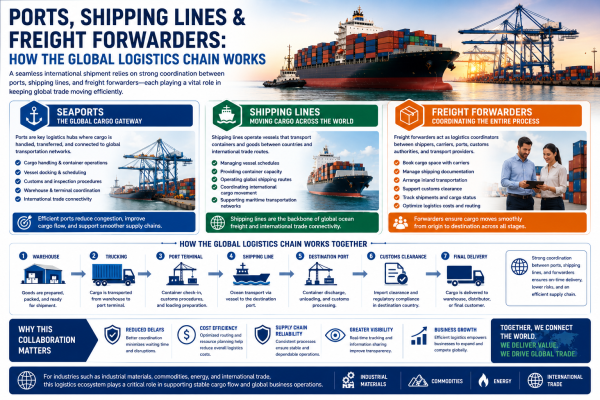
⚓ Seaports — The Global Cargo Gateway
Ports serve as major logistics hubs where containers and cargo are loaded, unloaded, stored, and transferred between transportation networks.
Modern seaports support:
• Cargo handling & container operations
• Vessel docking & scheduling
• Customs and inspection procedures
• Warehouse & terminal coordination
• International trade connectivity
Efficient ports help reduce congestion, improve cargo flow, and support smoother supply chain operations.
🚢 Shipping Lines — Moving Cargo Across the World
Shipping lines operate vessels that transport containers and goods between countries and international trade routes.
Their responsibilities include:
• Managing vessel schedules
• Providing container capacity
• Operating global shipping routes
• Coordinating international cargo movement
• Supporting maritime transportation networks
Shipping lines are the backbone of global ocean freight and international trade connectivity.
📦 Freight Forwarders — Coordinating the Entire Process
Freight forwarders act as logistics coordinators between shippers, carriers, ports, customs authorities, and transportation providers.
They help businesses:
• Book cargo space with carriers
• Manage shipping documentation
• Arrange inland transportation
• Support customs clearance
• Track shipments and cargo status
• Optimize logistics costs and routing
Forwarders help ensure cargo moves smoothly from origin to destination across multiple transportation stages.
🌐 How the Global Logistics Chain Works Together
A typical international shipment often follows this process:
Warehouse → Trucking → Port Terminal → Shipping Line → Destination Port → Customs → Final Delivery
Smooth coordination between ports, shipping lines, and freight forwarders is essential to avoid delays, reduce operational risks, and maintain supply chain efficiency.
For industries such as industrial materials, commodities, energy, and international trade, this logistics ecosystem plays a critical role in supporting stable cargo flow and global business operations.
As supply chains continue to evolve, businesses that understand and optimize these logistics connections will be better positioned to improve efficiency and compete in international markets.
#KTEnergyGlobal #Logistics #SupplyChain #GlobalTrade #FreightForwarding #ShippingLine #Seaport #MaritimeLogistics #InternationalTrade