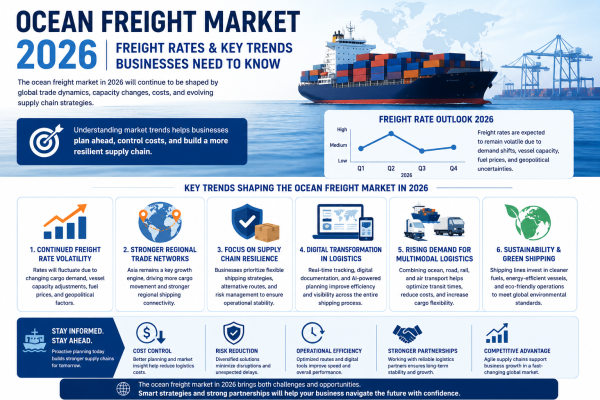
As global trade continues to evolve, the ocean freight market in 2026 is expected to remain highly dynamic, influenced by shifting supply chain strategies, regional trade growth, operational costs, and changing transportation demand.
For import-export businesses, understanding freight market trends is becoming increasingly important for controlling logistics costs and maintaining stable supply chain operations.
Several key trends are expected to shape the shipping industry in 2026:
• Continued Freight Rate Volatility
Freight rates are expected to fluctuate due to changing cargo demand, vessel capacity adjustments, fuel prices, and geopolitical factors affecting global trade routes.
• Stronger Regional Trade Networks
Asia continues to strengthen its role as a major manufacturing and logistics hub, increasing cargo movement across regional shipping routes.
• Increased Focus on Supply Chain Resilience
Businesses are prioritizing logistics stability, diversified transportation routes, and flexible shipping strategies to reduce operational risks.
• Digital Transformation in Logistics
Real-time cargo tracking, digital documentation, and AI-supported logistics planning are becoming more common across international shipping operations.
• Rising Demand for Multimodal Logistics
Companies are increasingly combining sea, road, rail, and air transportation to optimize transit times and improve cargo flexibility.
• Sustainability & Green Shipping Initiatives
Shipping lines and logistics providers are investing in cleaner operations, fuel efficiency, and environmental compliance as sustainability standards continue to grow globally.
For businesses operating in industrial materials, commodities, energy, and bulk cargo sectors, freight market awareness and logistics flexibility will remain essential competitive advantages in 2026.
As the shipping industry continues to adapt to global market changes, companies that build stable logistics partnerships and proactive supply chain strategies will be better positioned to manage costs, reduce risks, and capture new international trade opportunities.
#KTEnergyGlobal #OceanFreight #Logistics2026 #SupplyChain #GlobalTrade #FreightMarket #MaritimeLogistics #BulkCargo #FreightSolutions