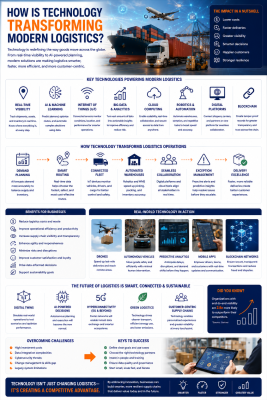
The logistics industry is experiencing one of the biggest transformations in its history. As global trade becomes more complex and customer expectations continue to rise, technology is reshaping how goods are moved, tracked, and managed across supply chains.
Today, modern logistics is no longer driven solely by transportation assets—it is increasingly powered by data, automation, connectivity, and intelligent decision-making.
📡 Real-Time Visibility Across the Supply Chain
One of the most significant changes in logistics is the ability to monitor shipments in real time.
Modern tracking systems allow businesses to:
• Track cargo locations instantly
• Receive shipment status updates
• Monitor potential delays
• Improve communication with customers
Greater visibility helps companies make faster and more informed decisions.
🤖 Automation Is Increasing Efficiency
Automation is reducing manual processes across logistics operations.
Examples include:
• Automated warehouses
• Smart inventory management systems
• Digital documentation processing
• Automated cargo handling equipment
These technologies help improve accuracy, reduce errors, and increase productivity.
📊 Data-Driven Decision Making
Modern logistics generates vast amounts of operational data.
Businesses now use analytics to:
• Forecast demand more accurately
• Optimize transportation routes
• Improve inventory planning
• Identify supply chain risks
Data is becoming a strategic tool for improving both efficiency and profitability.
🧠 Artificial Intelligence (AI) in Logistics
AI is helping logistics providers make smarter operational decisions.
Applications include:
• Route optimization
• Demand forecasting
• Capacity planning
• Predictive maintenance
• Risk assessment
By analyzing large datasets quickly, AI helps businesses improve responsiveness and reduce uncertainty.
🌐 Internet of Things (IoT) & Smart Cargo Monitoring
Connected sensors and IoT devices provide real-time information about cargo conditions.
Businesses can monitor:
• Location tracking
• Temperature control
• Humidity levels
• Cargo security
• Equipment performance
This is particularly valuable for high-value, sensitive, or perishable goods.
📱 Digital Platforms & Customer Experience
Technology is also transforming how customers interact with logistics providers.
Modern digital platforms offer:
✔ Online shipment management
✔ Instant quotations
✔ Electronic documentation
✔ Real-time updates
✔ Faster communication
The result is a more transparent and efficient customer experience.
🌱 Supporting Sustainable Logistics
Technology is helping the industry reduce its environmental impact through:
• Route optimization to reduce fuel consumption
• Smart fleet management
• Digital documentation to reduce paper usage
• Energy-efficient warehouse operations
Sustainability and technology are becoming increasingly interconnected.
🚀 The Future of Logistics Is Digital
As supply chains continue to evolve, technology is no longer a competitive advantage—it is becoming a necessity.
Companies that embrace digital transformation can achieve:
• Greater operational efficiency
• Better supply chain visibility
• Faster decision-making
• Improved customer satisfaction
• Stronger resilience against disruptions
Because in modern logistics, success is no longer determined solely by how goods move—but by how effectively information moves alongside them.
#KTEnergyGlobal #Logistics #Logistics40 #DigitalTransformation #SupplyChain #GlobalTrade #SmartLogistics #FreightForwarding #MaritimeLogistics #TechnologyInLogistics