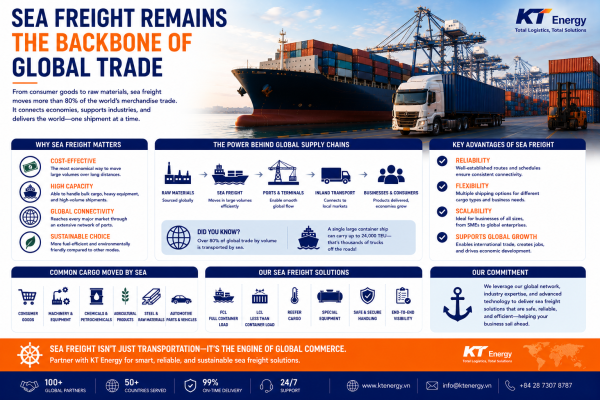
Despite the rapid growth of air freight, digital commerce, and alternative transportation solutions, ocean freight continues to serve as the foundation of international trade. Today, approximately 80–90% of global trade by volume is transported by sea, making maritime logistics one of the most important drivers of the global economy.
From industrial materials and energy products to consumer goods and manufacturing components, sea freight plays a critical role in connecting suppliers, manufacturers, and markets across continents.
🚢 Why Sea Freight Remains Essential
One of the biggest advantages of ocean transportation is its ability to move large volumes of cargo efficiently and cost-effectively.
Sea freight is particularly suitable for:
• Bulk commodities
• Industrial materials
• Machinery and equipment
• Containerized cargo
• Energy and raw materials
• Large-scale import and export operations
For many industries, there is simply no practical alternative for moving such significant cargo volumes internationally.
📦 Cost Efficiency at Scale
Compared with other transportation modes, sea freight offers significant cost advantages for large shipments.
Businesses benefit from:
• Lower transportation costs per unit
• High cargo capacity
• Flexible container options
• Global trade route connectivity
This makes sea freight the preferred choice for companies seeking long-term logistics efficiency.
🌐 Connecting Global Supply Chains
Modern supply chains depend on maritime transportation to support international production and trade.
Sea freight helps connect:
• Manufacturing hubs
• Global sourcing markets
• Distribution centers
• Industrial supply chains
• International consumers
Without efficient ocean transportation networks, global trade would struggle to operate at its current scale.
⚓ The Role of Ports and Shipping Networks
The growth of modern seaports, shipping lines, and logistics infrastructure has significantly improved the speed and reliability of maritime transportation.
Today’s shipping ecosystem includes:
• Advanced port terminals
• Global vessel networks
• Digital cargo tracking systems
• Integrated logistics services
• Multimodal transportation connections
These developments continue to strengthen the role of sea freight in international commerce.
📈 Adapting to a Changing Market
While the industry faces challenges such as freight rate volatility, port congestion, and evolving environmental regulations, sea freight continues to adapt through:
• Digital transformation
• Smart logistics technologies
• Sustainable shipping initiatives
• Supply chain optimization strategies
These innovations are helping improve efficiency and resilience across global maritime logistics.
🚀 The Foundation of International Trade
As global trade continues to expand, ocean freight remains one of the most reliable and scalable transportation solutions available.
For businesses involved in manufacturing, commodities, industrial materials, energy, and international commerce, sea freight is not simply a transportation option—it is a strategic pillar of global supply chain success.
Because while logistics continues to evolve, sea freight remains the backbone that keeps global trade moving forward.
#KTEnergyGlobal #SeaFreight #Logistics #GlobalTrade #SupplyChain #MaritimeLogistics #InternationalShipping #FreightForwarding #BulkCargo #OceanFreight