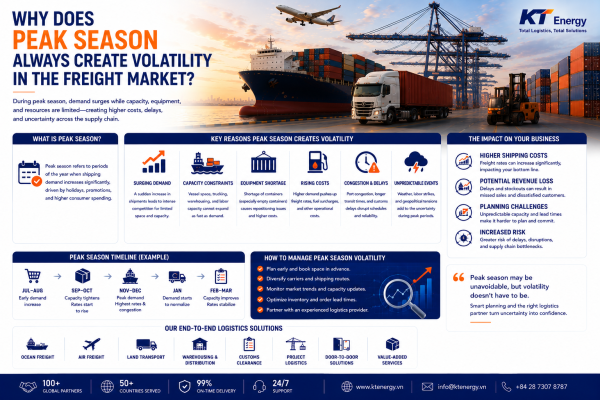
Every year, the international logistics industry experiences periods when freight rates rise, capacity becomes tighter, and transportation schedules become less predictable. These periods, commonly known as Peak Seasons, often create significant volatility across the global freight market.
For importers, exporters, and logistics providers, understanding the reasons behind these fluctuations is essential for better planning and cost control.
📦 Demand Increases Faster Than Capacity
The primary driver of peak season volatility is the imbalance between cargo demand and available transportation capacity.
During peak periods, businesses increase shipments to:
• Replenish inventory
• Prepare for holiday sales
• Meet seasonal demand
• Fulfill year-end purchasing cycles
When cargo volumes surge faster than available vessel space, freight rates typically increase.
🚢 Limited Vessel & Container Availability
Shipping capacity cannot always expand immediately to match demand.
During peak seasons, businesses may face:
• Limited vessel space
• Container shortages
• Equipment imbalances
• Longer booking lead times
As capacity becomes constrained, competition for available space intensifies.
⚓ Port Congestion Becomes More Common
Higher cargo volumes place additional pressure on ports and terminals.
This can result in:
• Longer vessel waiting times
• Delayed cargo handling
• Terminal congestion
• Increased container dwell times
Congestion often creates ripple effects throughout the entire supply chain.
📈 Freight Rates Respond to Market Pressure
As demand rises and capacity tightens, carriers may introduce:
• Peak Season Surcharges (PSS)
• General Rate Increases (GRI)
• Equipment imbalance fees
• Capacity management adjustments
These factors contribute to rapid freight rate fluctuations during busy periods.
🌐 Global Supply Chains Become More Sensitive
Peak season volatility is often amplified by other market conditions such as:
• Geopolitical events
• Fuel price fluctuations
• Weather disruptions
• Labor shortages
• Regulatory changes
Even small disruptions can have a larger impact when logistics networks are already operating near full capacity.
🚛 Inland Logistics Also Faces Pressure
The effects of peak season are not limited to ocean freight.
Businesses may also experience:
• Trucking shortages
• Warehouse capacity constraints
• Longer loading and unloading times
• Increased domestic transportation costs
As a result, the entire logistics ecosystem becomes more challenging to manage.
🚀 Preparation Is the Best Strategy
While peak season volatility cannot be avoided entirely, businesses can reduce its impact by:
✔ Booking shipments earlier
✔ Improving demand forecasting
✔ Maintaining flexible logistics plans
✔ Monitoring market trends closely
✔ Building strong logistics partnerships
Companies that prepare proactively are often better positioned to secure capacity, control costs, and maintain supply chain stability.
🌍 Peak Season Is a Test of Supply Chain Planning
Freight market volatility during peak season is not simply the result of higher demand—it’s the result of multiple supply chain pressures occurring simultaneously.
Businesses that understand these dynamics can make smarter logistics decisions and navigate peak season with greater confidence.
Because in global logistics, the companies that plan ahead are usually the ones that perform best when the market becomes most challenging.
#KTEnergyGlobal #Logistics #FreightMarket #PeakSeason #SupplyChain #OceanFreight #GlobalTrade #FreightForwarding #MaritimeLogistics #InternationalShipping