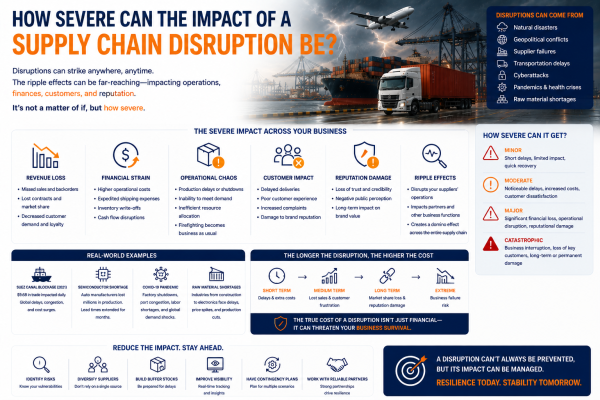
In today’s interconnected global economy, supply chains have become more complex than ever. Raw materials, manufacturing, transportation, warehousing, and distribution are all linked together in a continuous flow.
When one part of the chain breaks down, the consequences often extend far beyond a delayed shipment.
🏭 Production Can Come to a Standstill
Many manufacturers rely on a steady flow of materials and components to keep operations running.
When supplies are delayed or unavailable:
• Production schedules are disrupted
• Factory output declines
• Labor productivity is affected
• Customer orders cannot be fulfilled on time
For some industries, even a short interruption can result in significant financial losses.
📦 Inventory Shortages Affect Sales
A supply chain disruption often leads to inventory imbalances.
Businesses may experience:
• Stock shortages
• Lost sales opportunities
• Empty shelves or delayed deliveries
• Reduced ability to meet customer demand
In competitive markets, customers may turn to alternative suppliers when products are unavailable.
💰 Operational Costs Increase
Supply chain disruptions frequently generate unexpected expenses such as:
• Emergency transportation costs
• Additional warehousing fees
• Higher procurement expenses
• Overtime labor costs
• Expedited shipping charges
These costs can quickly erode profit margins and impact overall business performance.
🚢 Delivery Commitments Are Missed
When shipments are delayed, businesses may struggle to meet customer expectations.
Potential consequences include:
• Contract penalties
• Delayed project timelines
• Customer complaints
• Reduced service levels
Reliability is often a key factor in maintaining long-term customer relationships.
🤝 Customer Trust Can Be Damaged
The impact of a supply chain disruption is not only operational—it can also affect a company’s reputation.
Repeated disruptions may lead to:
• Loss of customer confidence
• Reduced customer loyalty
• Negative brand perception
• Difficulty securing future business
Trust can take years to build but only a short time to lose.
🌐 Ripple Effects Across the Entire Network
Supply chains are interconnected systems.
A disruption affecting one supplier, port, carrier, or warehouse can create a domino effect across:
• Manufacturers
• Distributors
• Logistics providers
• Retailers
• End customers
What starts as a local issue can quickly become a global operational challenge.
🚀 Resilience Is More Important Than Ever
To reduce the impact of supply chain disruptions, businesses are increasingly investing in:
✔ Supply chain visibility
✔ Diversified supplier networks
✔ Flexible logistics solutions
✔ Strategic inventory planning
✔ Strong logistics partnerships
✔ Risk management strategies
The goal is not to eliminate every disruption, but to recover quickly when disruptions occur.
🌍 Supply Chain Stability Supports Business Stability
In modern commerce, supply chains are the foundation of business operations. When they function efficiently, products move smoothly and customers remain satisfied. When they break down, the financial and operational consequences can be substantial.
Because in today’s global market, a supply chain disruption is rarely just a logistics problem—it can become a business-wide challenge affecting costs, customers, and long-term growth.
#KTEnergyGlobal #SupplyChain #Logistics #GlobalTrade #SupplyChainResilience #RiskManagement #FreightForwarding #MaritimeLogistics #BusinessContinuity #InternationalLogistics