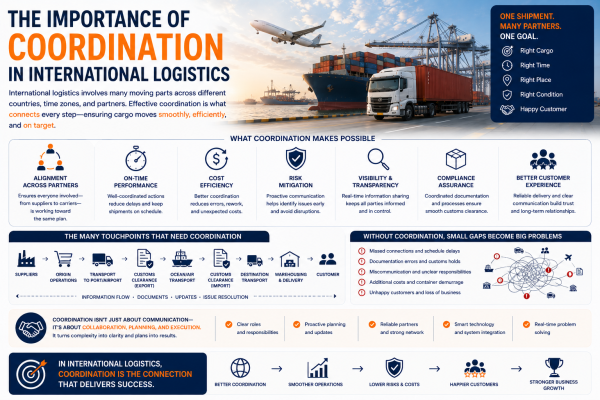
In international logistics, success is not determined solely by transportation capacity, freight rates, or shipping schedules. Behind every successful shipment lies one critical factor that connects the entire supply chain: coordination.
From the moment cargo leaves a factory until it reaches the final customer, multiple parties must work together seamlessly to ensure smooth operations and timely delivery.
🌐 Logistics Is a Network of Connected Activities
An international shipment typically involves:
• Suppliers and manufacturers
• Warehouses and distribution centers
• Trucking companies
• Freight forwarders
• Shipping lines or airlines
• Port operators
• Customs authorities
• Consignees
Each participant plays a specific role, and a delay in one stage can affect the entire logistics chain.
🚛 Coordination Prevents Operational Delays
Many logistics disruptions occur not because of transportation issues, but because of poor communication and planning between stakeholders.
Examples include:
• Cargo not ready when trucks arrive
• Documentation submitted late
• Missed port cut-off times
• Incorrect shipment information
• Misaligned transportation schedules
Effective coordination helps ensure that every activity follows the same operational timeline.
📦 Better Coordination Improves Supply Chain Visibility
When all parties share information efficiently, businesses gain:
✔ Real-time shipment updates
✔ Faster problem identification
✔ Improved planning accuracy
✔ Better decision-making capabilities
Visibility allows businesses to proactively manage risks rather than react to problems after they occur.
⚡ Faster Response During Disruptions
Unexpected events are common in global logistics, including:
• Vessel delays
• Port congestion
• Customs inspections
• Capacity shortages
• Weather-related disruptions
Strong coordination enables logistics teams to:
• Communicate quickly
• Identify alternative solutions
• Minimize operational impact
• Maintain customer commitments
The ability to respond effectively often determines the success of a shipment.
💰 Coordination Helps Control Costs
Poor coordination can lead to:
• Storage charges
• Demurrage and detention fees
• Additional trucking costs
• Missed vessel departures
• Emergency transportation expenses
By keeping all parties aligned, businesses can reduce unnecessary costs and improve overall logistics efficiency.
🤝 Coordination Builds Customer Confidence
Customers value reliability and transparency.
A well-coordinated logistics process helps businesses:
• Deliver on time
• Provide accurate updates
• Reduce shipment uncertainty
• Improve customer satisfaction
In many cases, customer trust is built through consistent operational execution.
🚀 Logistics Success Depends on Teamwork
International logistics is not a series of independent activities—it is one continuous process that requires constant communication and collaboration.
Companies that prioritize coordination across suppliers, carriers, warehouses, customs authorities, and logistics partners often achieve:
• Greater operational efficiency
• Better supply chain resilience
• Lower logistics costs
• Stronger customer relationships
Because in international logistics, cargo moves through transportation networks—but successful shipments move through coordination.
#KTEnergyGlobal #Logistics #SupplyChain #Coordination #GlobalTrade #FreightForwarding #InternationalShipping #MaritimeLogistics #SupplyChainManagement #OperationalEfficiency