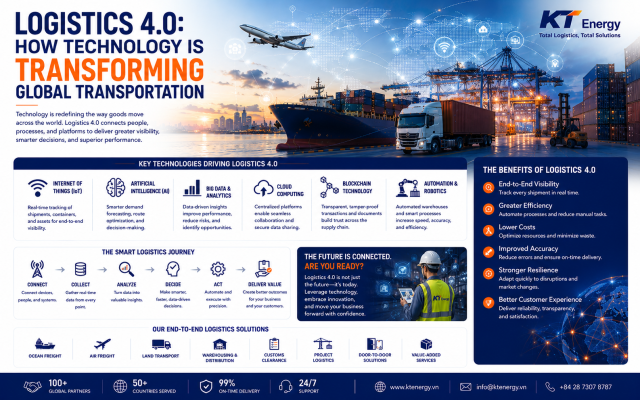
The logistics industry is undergoing a major transformation driven by digital innovation, automation, and data-driven decision-making. As global supply chains become more complex, businesses are increasingly adopting advanced technologies to improve efficiency, visibility, and operational performance.
This new era, often referred to as Logistics 4.0, is reshaping how goods move across international markets and how supply chains are managed in real time.
🚀 What Is Logistics 4.0?
Logistics 4.0 refers to the integration of advanced technologies into logistics and supply chain operations, enabling smarter, faster, and more connected transportation networks.
It combines digital tools, automation, and real-time data to improve decision-making and operational efficiency.
📡 Real-Time Tracking & Visibility
Modern logistics platforms allow businesses to monitor cargo movement throughout the entire supply chain.
Benefits include:
• Real-time shipment tracking
• Improved transparency
• Faster issue identification
• Better customer communication
Greater visibility helps companies respond more quickly to disruptions and delays.
🤖 Automation & Smart Operations
Automation is helping logistics providers streamline repetitive processes and improve operational accuracy.
Applications include:
• Automated warehouses
• Smart inventory management
• Digital documentation processing
• Route optimization systems
These technologies reduce manual errors and increase productivity.
📊 Big Data & Predictive Analytics
Data has become one of the most valuable assets in modern logistics.
By analyzing large volumes of operational data, businesses can:
• Forecast demand more accurately
• Optimize transportation planning
• Improve inventory management
• Reduce logistics costs
Predictive analytics also helps identify potential supply chain risks before they occur.
🌐 Internet of Things (IoT)
Connected devices and sensors are enabling smarter cargo monitoring across global supply chains.
IoT technologies can provide:
• Temperature monitoring
• Location tracking
• Cargo condition reporting
• Equipment performance insights
This is especially important for sensitive or high-value shipments.
🧠 Artificial Intelligence (AI)
AI is increasingly being used to support logistics planning and decision-making.
Examples include:
• Route optimization
• Capacity forecasting
• Demand prediction
• Supply chain risk assessment
AI-powered systems help businesses improve efficiency while reducing operational uncertainty.
🌍 The Future of Global Logistics
As international trade continues to evolve, Logistics 4.0 is becoming a competitive necessity rather than an optional advantage.
Businesses that embrace digital transformation can benefit from:
✔ Faster operations
✔ Greater supply chain visibility
✔ Better cost control
✔ Improved customer experience
✔ Stronger operational resilience
For industries such as energy, industrial materials, commodities, manufacturing, and international trade, technology-driven logistics will play an increasingly important role in achieving long-term growth and competitiveness.
#KTEnergyGlobal #Logistics40 #SmartLogistics #SupplyChain #DigitalTransformation #GlobalTrade #FreightForwarding #MaritimeLogistics #AIinLogistics #FutureOfLogistics