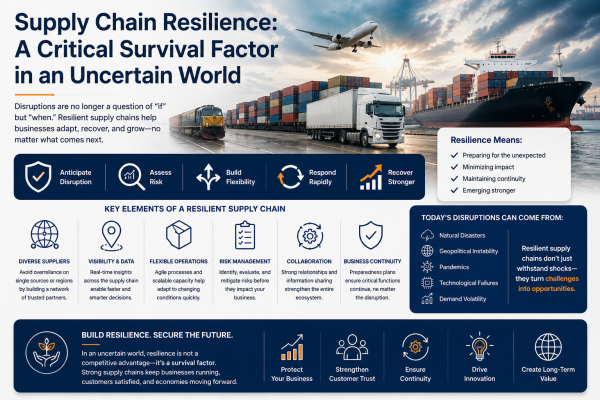
 In today’s business environment, disruptions have become increasingly common. From geopolitical tensions and port congestion to natural disasters, capacity shortages, and market volatility, supply chains face constant pressure from unexpected events.
As a result, Supply Chain Resilience has evolved from a competitive advantage into a business necessity.
🌐 What Is Supply Chain Resilience?
Supply chain resilience refers to a company’s ability to anticipate, adapt to, and recover from disruptions while maintaining operational continuity.
A resilient supply chain is not one that never faces problems—it is one that can respond quickly and continue operating effectively when challenges arise.
🚢 Why Resilience Matters More Than Ever
Modern supply chains are highly interconnected.
A disruption affecting one supplier, carrier, port, or transportation route can create ripple effects across the entire network.
Potential impacts include:
• Shipment delays
• Inventory shortages
• Production interruptions
• Increased logistics costs
• Missed customer commitments
The ability to recover quickly often determines business performance during uncertain times.
📦 Visibility Creates Resilience
Businesses cannot respond effectively to risks they cannot see.
Real-time visibility helps companies:
✔ Monitor shipment status
✔ Identify potential disruptions early
✔ Improve decision-making
✔ Coordinate responses more efficiently
The faster a business gains information, the faster it can take action.
🔄 Flexibility Reduces Risk
Resilient organizations avoid overreliance on a single solution.
They often maintain:
• Multiple sourcing options
• Alternative transportation routes
• Diverse logistics partners
• Flexible inventory strategies
Flexibility helps businesses adapt when market conditions change unexpectedly.
🤝 Strong Partnerships Strengthen Supply Chains
Reliable suppliers and logistics partners play a vital role in resilience.
Strong partnerships help businesses:
• Access alternative solutions quickly
• Improve communication during disruptions
• Enhance operational coordination
• Reduce recovery time
In times of uncertainty, collaboration becomes a valuable asset.
📈 Resilience Protects Profitability
Supply chain disruptions can create significant financial consequences.
A resilient supply chain helps minimize:
• Emergency transportation costs
• Production downtime
• Inventory shortages
• Customer service failures
• Revenue loss
Investing in resilience often costs far less than recovering from a major disruption.
🚀 Resilience Is the New Competitive Advantage
Leading companies no longer focus solely on efficiency and cost reduction.
They are increasingly investing in:
• Supply chain visibility
• Risk management capabilities
• Digital logistics solutions
• Strategic inventory planning
• Flexible logistics networks
The objective is not simply to move goods efficiently, but to maintain business continuity regardless of market conditions.
🌍 Preparing for an Unpredictable Future
The global business landscape will continue to evolve, and disruptions will remain a part of international trade.
Companies that build resilient supply chains are better positioned to adapt, recover, and continue growing even when faced with uncertainty.
Because in today’s world, supply chain resilience is no longer just about managing risk—it’s about ensuring long-term business survival and success.
#KTEnergyGlobal #SupplyChainResilience #Logistics #SupplyChain #GlobalTrade #RiskManagement #BusinessContinuity #FreightForwarding #MaritimeLogistics #InternationalLogistics